The short answer is: it depends on where you are in Canada and what service is being provided.
A local restaurant, a provincial retailer, and an airline do not necessarily operate under the same rules. The repeated American answer that businesses may always ask for a particular service dog ID is not a reliable answer in Canada. The law is shaped by provincial rules, federal transportation regulations, human rights protections, and the specific circumstances.
There is also no single Canadian service dog registry or federal certification system.
This article explains the difference between identification, documentation, certification, and behaviour so that handlers and businesses can approach these situations with greater confidence and care.
Melanie Burneau
Owner & Head Trainer
Pawsitively Service Dogs Inc.
The legal framework in Canada
Canada has both provincial and federal legal layers.
Restaurants, shops, housing providers, and most everyday public services are generally governed by provincial law. This may include provincial human rights legislation, service dog legislation, food-safety rules, and local bylaws.
Air, rail, marine, and interprovincial bus travel may fall under federal transportation regulation. The Accessible Transportation for Persons with Disabilities Regulations contain specific rules for service dogs travelling with passengers.
The Canadian Human Rights Act applies to federally regulated organizations and services. It does not generally govern a local restaurant or independent retail shop.
The Accessible Canada Act is also not the source of a universal service dog access right. The Act contains no service dog provisions, and the term does not appear in its definitions. It should not be used as though it creates a national service dog certification or ID system.
Under the federal and provincial laws reviewed, there is:
- No federal service dog registry.
- No federal service dog certification.
- No single national service dog card.
- No universal vest or harness standard that proves legal status.
Why the answer depends on where you are in Canada
A person may have a legitimate disability-related need for a service dog without carrying a government card. At the same time, a provincial certification program may give a team specific documentation and enforcement options.
A federally regulated airline may be allowed to request a document from a qualified service dog trainer. A local shop may not be entitled to demand the same document as a condition of entry.
That distinction matters.
There Is No Universal Canadian Service Dog ID
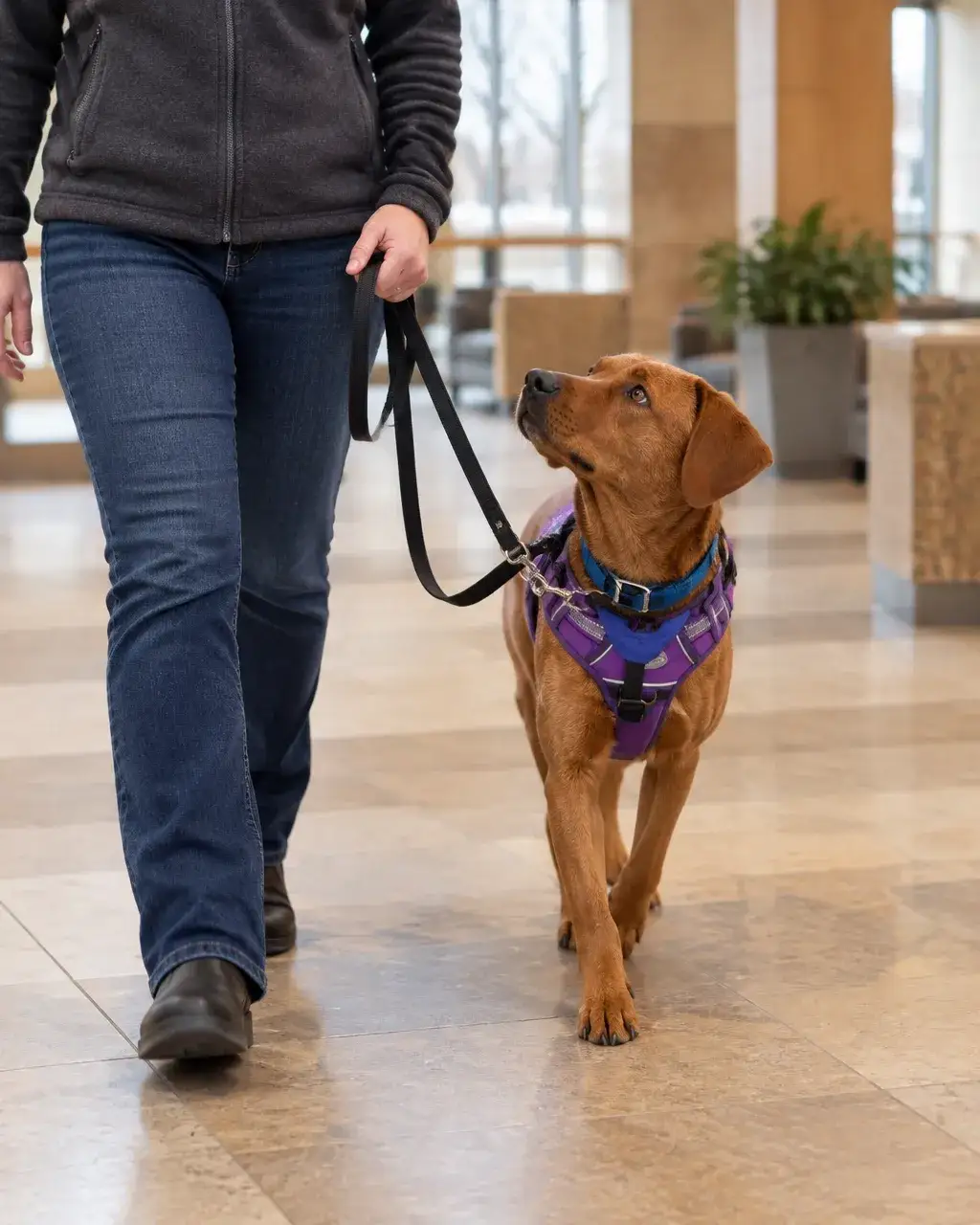
A business should not assume that every legitimate Canadian service dog will carry the same card, wear the same vest, or be certified through the same program.
A handler may have:
- A provincial certification card.
- An identification card from an accredited service dog school.
- Documentation from a trainer.
- No visible identification at all.
- A non-visible disability and no outward indication of disability.
A person with a non-visible disability may not look disabled, and the absence of a visible disability does not establish that a service dog is illegitimate.
The absence of a card is not, by itself, a reliable basis for questioning someone aggressively or publicly. The relevance of documentation depends on the jurisdiction, the service being provided, and the legal framework being relied upon.
Can staff ask for an ID?
Sometimes, but not as a universal Canadian rule.
For an ordinary provincial restaurant or shop, staff should first understand which provincial rules apply. In British Columbia, certification under the Guide Dog and Service Dog Act is voluntary. The BC Human Rights Commissioner states that certification papers cannot be required as a condition of service, and a legitimate team cannot be refused solely because it does not have provincial certification.
Nova Scotia has a voluntary provincial certification system under its Service Dog Act. A Nova Scotia identification card can provide proof that a team is certified under that Act. However, certification is not a national requirement, and the Act does not create a single Canadian standard.
For federally regulated transportation, the answer is different. Under the federal transportation regulations, a carrier may require an identification card or other document issued by an organization or person specializing in service dog training. The document must identify the handler and dog and attest to the dog’s individualized training for a disability-related task.
That document comes from the trainer or training organization. It does not come from a federal service dog registry.
The travel context is important. A carrier’s documentation requirements should not automatically be transferred to every restaurant, shop, landlord, or public service in Canada.
Can staff ask about someone’s disability?
They should not question a person about the nature of their disability.
A business should not ask:
- What diagnosis do you have?
- What happened to you?
- How severe is your condition?
- Can you prove that you are disabled?
- Why do you need a service dog?
Those questions seek private medical information and can be intrusive, humiliating, and discriminatory.
There is a difference between asking about a person’s diagnosis and asking a limited question about the dog’s role. Depending on the province and circumstances, a business may be able to ask whether the dog is a service dog required because of a disability. A transportation carrier may also have authority to request documentation addressing the dog’s training and disability-related task.
A respectful approach focuses on the animal and the service being requested. It does not require the handler to disclose a diagnosis.
What documentation might be required, and when?
The answer differs between a provincially regulated business and a federally regulated flight.
At a restaurant or retail shop
A business should check the law that applies in its province. In British Columbia, businesses should not make provincial certification papers a condition of service because certification is voluntary and valid teams may exist outside the provincial certification process.
In Nova Scotia, a provincial ID card is connected to certification under the Service Dog Act. The province’s system may be relevant when a team is relying on the specific rights and protections created by that Act. A business should still avoid demanding medical details or treating the lack of a card as automatic proof of fraud.
Human rights duties remain important. A team that is not voluntarily certified may still have protection under human rights law, depending on the province and the circumstances.
On a federally regulated flight or other transportation service
The Accessible Transportation for Persons with Disabilities Regulations allow a carrier to require:
- A declaration that the dog has been individually trained to perform a task assisting with a disability-related need.
- An identification card or other document from an organization or person specializing in service dog training.
- Information identifying both the handler and the dog.
These requirements relate to federally regulated transportation. They should not be confused with provincial government ID cards.
A carrier may also consider whether the dog is under control and able to travel safely. Documentation does not remove the handler’s responsibility to manage the dog.
Does a vest count as proof?
No.
A vest, harness, leash wrap, patch, or other piece of equipment is not federal certification or universal legal documentation. Anyone can purchase equipment marked “service dog.”
Equipment may communicate that a dog is working, but it does not establish:
- Who trained the dog.
- What tasks the dog performs.
- Whether the team is provincially certified.
- Whether the dog is safe and appropriate in a particular environment.
A business should not treat a vest as conclusive proof. It should also avoid treating the absence of a vest as conclusive proof that a dog is not legitimate. Some handlers may not use visible equipment for practical, medical, or personal reasons.
What about government certification in Nova Scotia?
Nova Scotia has a provincial certification system under the Service Dog Act. Certification is voluntary.
A certified team may receive a provincial identification card, and the card can serve as proof of certification under the provincial Act. The Act also includes requirements connected to identification equipment for teams operating within that framework.
However, handlers are not required to register their dogs simply to train or work with them. A handler who is not voluntarily certified may not be able to rely on every specific protection or enforcement mechanism created by the Service Dog Act, but that does not automatically resolve the human rights question.
The Nova Scotia Human Rights Act may still be relevant when a person requires a service dog as a disability-related accommodation.
For more detail, see How Service Dog Certification Works in Nova Scotia.
What about government certification in British Columbia?
British Columbia also has a voluntary certification system under the Guide Dog and Service Dog Act.
Teams may be certified through the provincial process, or may qualify through an accredited school route. However, certification is not mandatory. Handlers are not required to register their dogs simply to train or work with them.
The BC Human Rights Commissioner recognizes that valid guide and service dog teams can exist outside the provincial certification process. A business should not refuse service solely because a handler does not have provincial certification papers.
A provincial card may make recognition easier in some situations. It does not create the only possible path to disability protection.
For more detail, see How Service Dog Certification Works in British Columbia.
Certification in British Columbia, Alberta, and Nova Scotia is voluntary. The rules and practical effects differ in each province. Handlers are not required to register their dogs to train or work with them.
The province certifies teams; trainers prepare them. Pawsitively Service Dogs Inc. prepares handlers and dogs through structured, evidence-informed training. We do not certify teams or guarantee service dog status.
Documentation and Behaviour Are Different Questions
Whether someone meets the legal requirements for service dog accommodation is one question.
Whether a dog is behaving safely and appropriately in a particular environment is another.
A card, letter, vest, or certification document is not permission for uncontrolled or dangerous behaviour. A business can respond to genuine conduct concerns, including when a dog:
- Acts aggressively.
- Lunges at people or animals.
- Cannot be controlled by the handler.
- Repeatedly barks or disrupts the environment.
- Wanders away from the handler.
- Is not house-trained.
- Creates a real and immediate safety concern.
The response should be based on observable behaviour, not suspicion about disability or the dog’s appearance.
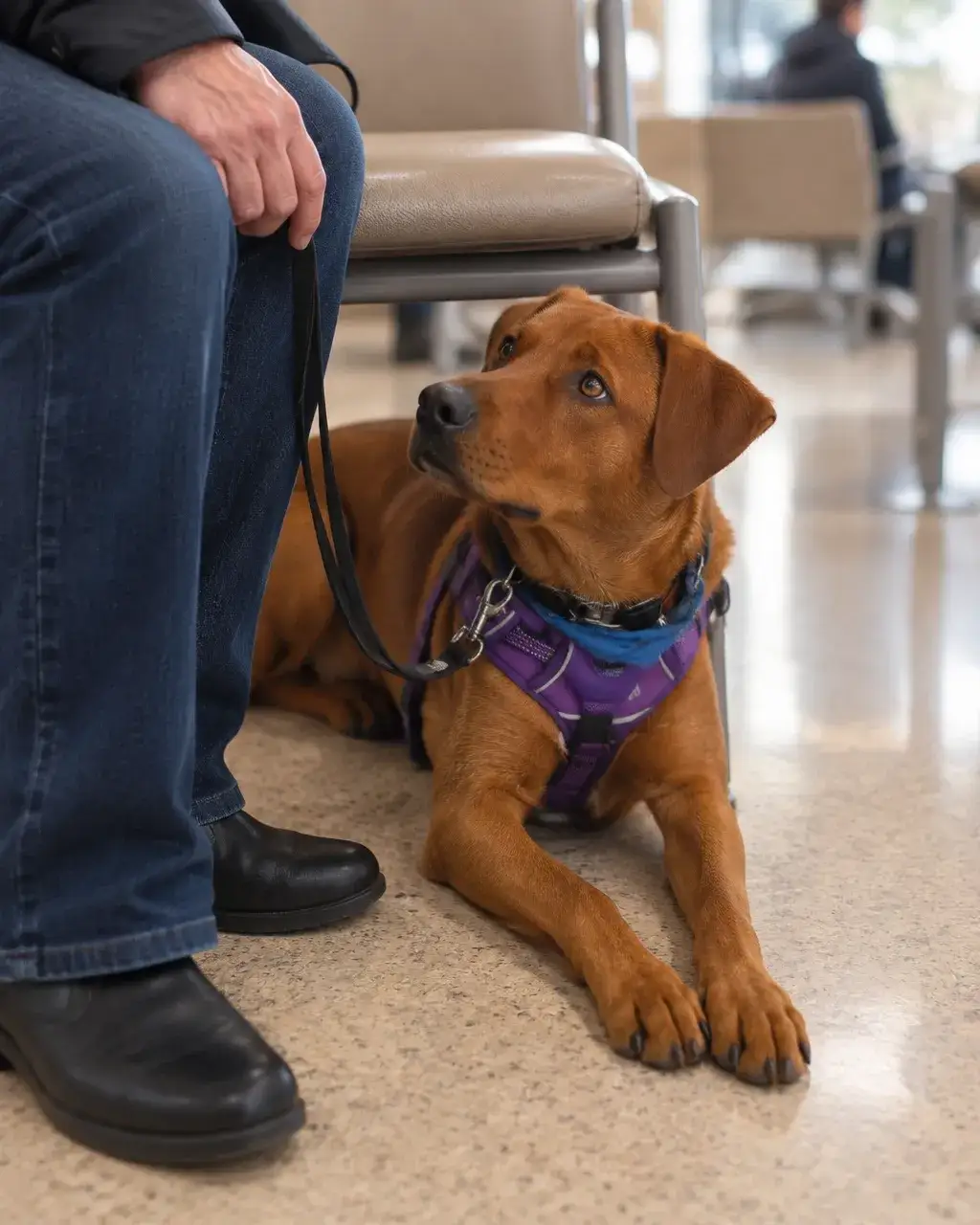
A business should avoid using a general “no pets” policy to remove a service dog that is behaving appropriately. A service dog is not being treated as an ordinary pet.
At the same time, disability accommodation does not require a business to accept dangerous or seriously disruptive conduct without response. Staff should describe what they observed, give the handler an opportunity to address the issue where appropriate, and apply reasonable safety procedures consistently.
A practical approach for businesses
When staff are unsure, a calm process is safer and more respectful than confrontation.
Begin with access.
Do not stop a person at the entrance or publicly challenge their disability. Allow the team to enter where the law requires access.
Ask only limited questions when appropriate.
Use neutral language, such as:
- “Is this a guide dog or service dog required because of a disability?”
- “Is the dog trained to perform a disability-related task?”
- “For this federally regulated travel service, may we review the required training document?”
Do not ask for a diagnosis or detailed medical history.
Observe behaviour.
A working dog should remain under the handler’s control and behave safely in the environment. Address specific conduct rather than making assumptions based on breed, equipment, or appearance.
Keep information private.
If documentation is legally relevant, review it discreetly. Do not announce a person’s disability or discuss their documents with other customers.
Offer an appropriate alternative when a legal exclusion applies.
Some areas may have specific health or safety restrictions. If a dog cannot enter a particular restricted area, the business should explain the reason and consider how the person can still receive the service.
An aggressive or suspicious approach is poor service and may also create legal risk. A respectful, consistent procedure protects both the handler and the business.
What should handlers do?
You can prepare for different settings without assuming that one card or vest will answer every question.
Consider:
- Checking the provincial rules where you live or travel.
- Carrying relevant documentation when a federally regulated carrier has requested it.
- Keeping your dog under control and focused on its work.
- Preventing avoidable disruption in public spaces.
- Responding calmly when a business asks a limited, lawful question.
- Recording details if you believe access was denied unfairly.
If you want to understand your training options, you can read Can You Train Your Own Service Dog in Canada?. You may also review Service Dogs in Restaurants in Canada and Fake Service Dog Registries: What They Are and Why They Don’t Certify Your Dog.
The practical answer
A business can sometimes ask for service dog documentation, but there is no universal Canadian answer.
The correct response depends on:
- The province.
- The type of business.
- Whether the service is federally regulated.
- Whether a provincial certification system applies.
- Whether the dog is behaving safely.
- The rights and circumstances of the person using the dog.
A vest is not proof. A federal registry does not exist. A person should not be required to disclose a diagnosis simply to enter a public business.
The most reliable approach is informed, respectful, and specific: understand the applicable law, ask only what is necessary, protect privacy, and address behaviour separately from documentation.
If you need guidance about service dog training or public access preparation, contact our team.
Nova Scotia: melanie@pawsitivelyservicedogs.ca
British Columbia: jenn@pawsitivelyservicedogs.ca
General inquiries: info@pawsitivelyservicedogs.ca