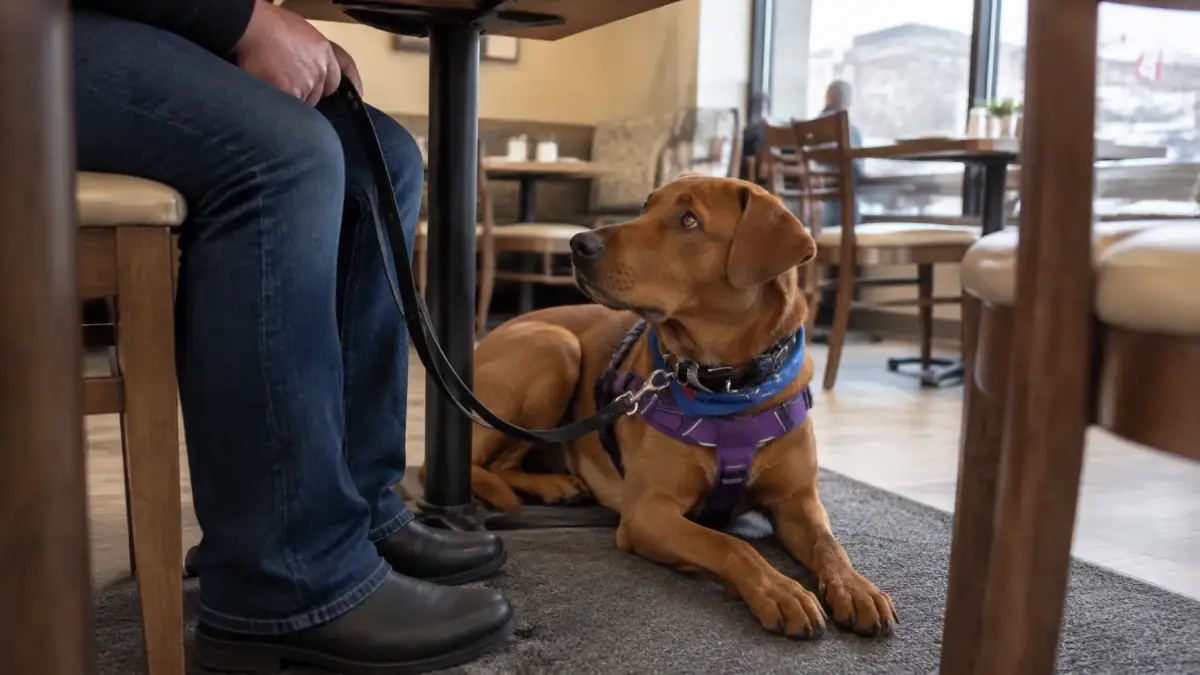
Understanding Access, Behaviour and Responsibilities in Food-Service Settings
Service dogs and restaurants can work well together when everyone understands the difference between access rights, food-safety boundaries and appropriate behaviour.
The first point is important: Canada does not have one nationwide restaurant-access rule equivalent to the American ADA. Restaurant access is shaped primarily by provincial legislation, provincial human-rights obligations and food-safety requirements. The rules can differ between provinces and between specific situations.
Businesses should also avoid relying on the American “two questions” script found online. That script comes from United States law. It is not Canadian law.
Instead, restaurants should follow the requirements that apply in their province, use respectful communication and focus on observable behaviour and legitimate safety concerns.
Dining Areas and Food-Preparation Areas
In general, access concerns the parts of a restaurant that are open to the public.
This usually includes:
- Dining rooms
- Customer service counters
- Public washrooms
- Customer-accessible bar areas
- Public patios
- Waiting areas and entrances
A service dog should be permitted to accompany its handler in these areas, subject to the applicable provincial rules and any genuine safety or food-contamination concerns.
Food-preparation areas are different. Kitchens, food-preparation counters, storage rooms, dishwashing areas and other staff-only spaces may be subject to food-safety restrictions. A service dog’s access rights do not normally extend to areas where the public cannot go or where food is prepared, processed or stored.
The exact wording varies by province:
- In British Columbia, food-premises rules distinguish between customer areas and areas where food is prepared, processed or stored.
- In Nova Scotia, food-safety guidance recognizes service dog access where permitting the dog does not create a risk of contaminating food, while public-access rights apply to places where the public is invited or allowed.
- In Alberta, provincial guidance expressly identifies food-preparation areas as non-public areas outside the ordinary public-access right.
This distinction is not a way to avoid access. It is a way to balance access with legitimate food-safety requirements.
A restaurant should not use a kitchen restriction to exclude a handler from the dining room. Similarly, a handler should not expect a service dog to enter a staff-only food-preparation space.
What Appropriate Behaviour Looks Like
A service dog being allowed in a restaurant does not mean the dog can do anything.
Access and behaviour are separate questions. A legitimate service dog team still has responsibilities in a shared public environment.
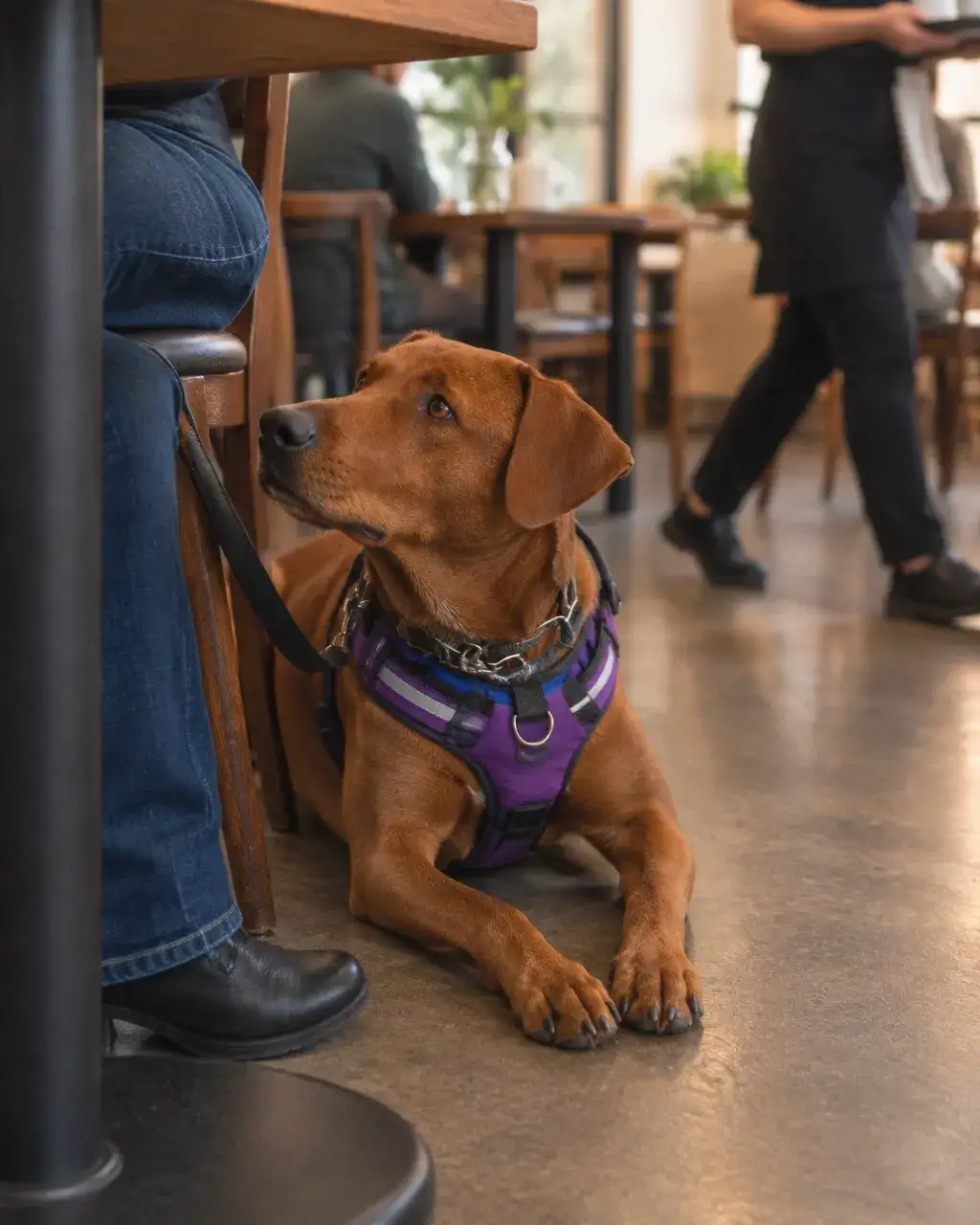
Appropriate behaviour generally means that the dog:
- Remains under the handler’s control
- Settles quietly beside or under the table
- Stays clear of aisles and walkways
- Does not approach other diners
- Does not interfere with staff
- Does not occupy a chair or table
- Does not eat from tables or floors
- Does not bark, lunge, growl or snap
- Does not create a genuine safety or disruption problem
The dog’s exact position will depend on the handler’s needs and the restaurant’s layout. Under the table may be appropriate for one team. Beside the handler may be safer for another. The important standard is that the dog remains unobtrusive, controlled and safely positioned.
Handlers should also plan for the physical demands of a restaurant. Tight spaces, dropped food, busy servers and unfamiliar sounds can challenge even a well-trained dog. Public-access skills need to be developed gradually and maintained through regular practice.
Our guide to service dog public access training explains how teams can build these skills in a structured way.
Why Food Scavenging Matters
Food scavenging is especially serious in a restaurant.
Dropped food is common. A dog may find food under a table before the handler sees it. Some foods may be unsafe for dogs, and sudden movement toward the floor can create a trip hazard or pull the handler off balance.
Table height creates another challenge. A dog that has learned to investigate household tables may be able to reach plates, napkins or utensils in a restaurant. Other diners may interpret this as begging or may feel uncomfortable having a dog near their meal.
Food-seeking can also distract a dog from its handler. A service dog that repeatedly scans the floor, noses at tables or pulls toward food is not demonstrating the calm neutrality expected in a restaurant.
Handlers should:
- Feed the dog before an outing when appropriate
- Bring reinforcement that can be delivered without encouraging begging
- Practise ignoring dropped food
- Keep the dog close and positioned safely
- Monitor the dog’s stress and fatigue
- Leave if the dog cannot settle reliably
Restaurant staff and other diners should not offer food to a service dog. Feeding can interfere with the dog’s training, make the dog ill or reduce its ability to focus on disability-related work.
Barking, Whining and Disruptive Behaviour
Quiet does not mean motionless. A service dog may adjust position, respond to a cue or assist its handler. Normal, brief movement is not the same as disruptive behaviour.
Repeated barking, persistent whining, growling, lunging, snapping, wandering or interfering with service can affect other customers and staff. These behaviours may indicate stress, inadequate preparation, illness or that the environment is not appropriate for the dog at that time.
A business can address a genuine safety or disruption problem. Provincial rules vary, but a dog that is aggressive, uncontrolled or unduly disruptive may be removed or the team may be asked to leave for that visit.
The response should be specific and proportionate. Staff should describe what they observed rather than make assumptions about the handler or the dog.
For example:
“Your dog has been repeatedly entering the aisle and approaching other customers. We need the dog to remain beside you and clear of the walkway. If that cannot happen, we will need to pause service and discuss next steps.”
This is different from refusing service because a dog is present, because the handler has a non-visible disability or because the dog does not match someone’s expectations.
Allergies and Fear of Dogs
Allergies and fear of dogs are real concerns. They should not be dismissed.
At the same time, a restaurant must balance those concerns with the handler’s disability-related access rights. The usual goal is not to exclude the service dog team or isolate the handler. It is to reduce unnecessary proximity where the layout allows.
Possible measures may include:
- Seating customers farther apart
- Keeping a service dog out of a narrow walkway
- Asking staff to use an alternate route
- Avoiding direct contact with the dog
- Offering a different table when reasonably available
- Allowing the handler to choose a suitable location
Businesses should not assume that placing every service dog team at a separate entrance, outside area or isolated section is an acceptable default. Accommodation should be individualized and consistent with the rules that apply in the province.
Handlers can also help by requesting a quieter table, keeping the dog close and respecting reasonable operational boundaries.
Respectful Questions for Restaurant Staff
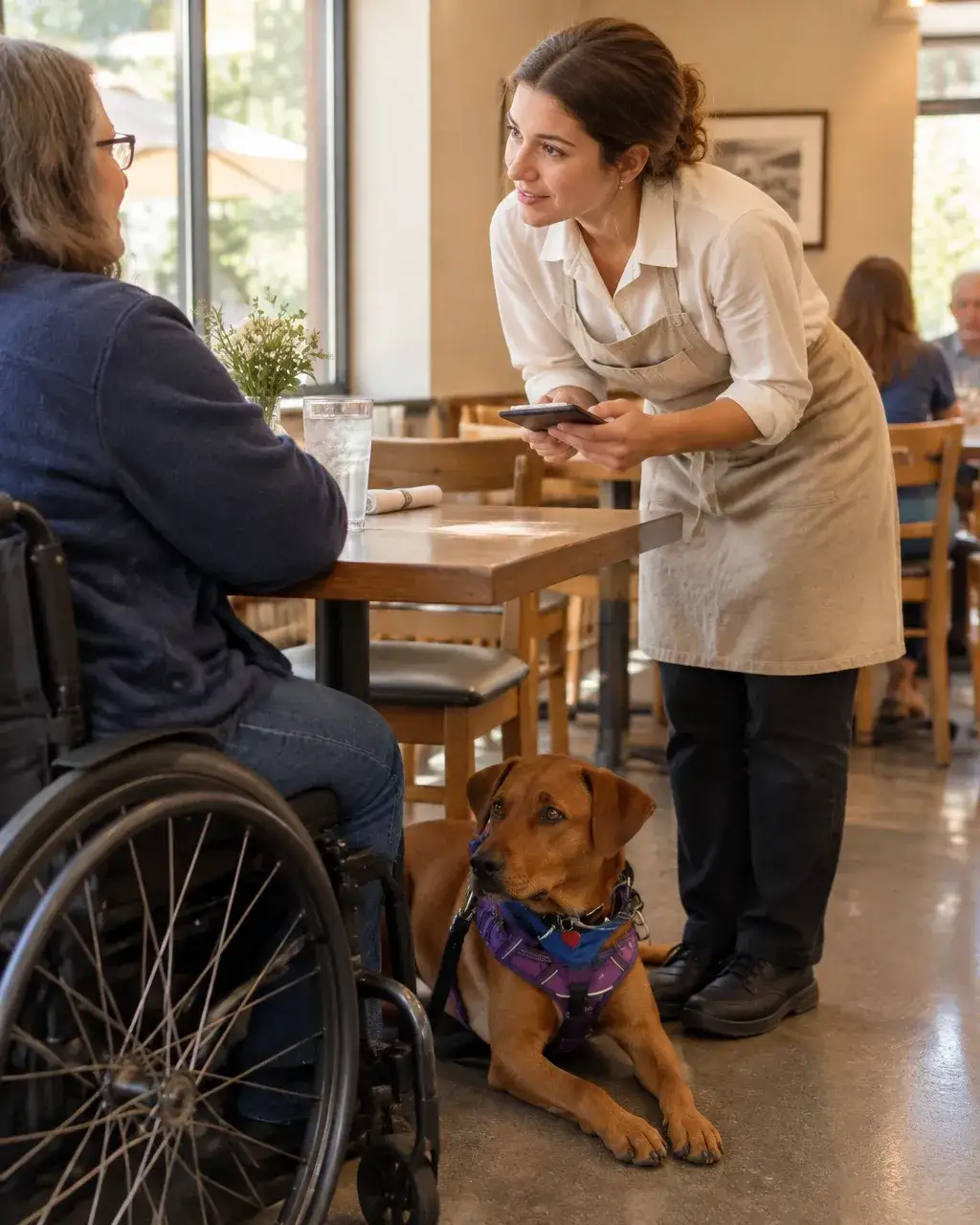
Staff should speak to the handler, not the dog. They should not ask about the person’s diagnosis, medical history or personal lived experience.
A respectful approach may sound like:
“Welcome. I want to make sure we support your access while keeping the dog clear of food-preparation areas. Can I confirm that this is a service dog?”
If there is a specific behaviour concern:
“I’m concerned because your dog has entered the walkway several times. Could you please keep the dog beside or under your table?”
If the dog is approaching food:
“We need the dog to remain away from the tables and not take food from the floor. Can we help you find a safer position?”
Questions should be limited to what is necessary for access, safety and service. Staff should not demand a demonstration of tasks, ask personal questions or treat a vest as a substitute for respectful judgment.
Businesses Shouldn’t Assume a Dog Is Fake Because It Doesn’t Look Like They Expected
Breed, size, colour, equipment or vest style are not reliable indicators of legitimacy.
Many disabilities are invisible. Service dogs may assist with mobility, medical alerts, psychiatric disabilities, sensory disabilities or other disability-related needs. There is no single recognized Canadian service dog vest that every legitimate team must wear.
There is also no national Canadian service dog registry or certification card that functions as a universal test for every restaurant and every province. A business cannot rely on a blanket “check the card” policy as a complete national solution.
Certification systems and legal protections differ. In British Columbia, Alberta and Nova Scotia, certification is voluntary, and handlers are not required to register their dogs simply to train or work with them. However, provincial certification may provide specific statutory rights, identification or enforcement options in particular circumstances.
The province certifies teams; trainers prepare them. Pawsitively Service Dogs Inc. does not certify service dog teams or guarantee that a dog will receive service dog status.
You can learn more about the limits of commercial registration through our article on fake service dog registries.
Provincial and Federal Responsibilities
Most restaurants are governed by provincial and municipal rules, including provincial human-rights legislation and food-safety requirements.
The federal layer is narrower. The Accessible Canada Act applies primarily to federally regulated organizations and establishes a framework for identifying, preventing and removing accessibility barriers. The Canadian Human Rights Act applies to federally regulated services and organizations. Federal transportation regulations also address service dogs travelling with passengers on federally regulated airlines, railways, ferries and other transportation services.
These federal rules do not create one universal restaurant rule for every restaurant in Canada. Jurisdiction matters. A local restaurant will usually need to look to the law and guidance in its province, while a federally regulated transportation provider may have additional obligations.
This is why general online advice can be misleading. A rule that applies to a federally regulated airline, a British Columbia food premise or a certified Nova Scotia team may not apply in exactly the same way elsewhere.
A Practical Standard for Everyone
For handlers, the goal is a dog that can enter a restaurant, remain focused and settle safely without interfering with other people.
For businesses, the goal is to provide equal service, protect food safety and respond calmly to genuine behaviour concerns.
A practical checklist is:
For handlers
- Confirm that your dog can settle before choosing a busy restaurant.
- Keep your dog out of aisles and away from tables.
- Prevent food scavenging and begging.
- Respect staff-only and food-preparation boundaries.
- Leave if your dog cannot remain safe and controlled.
For businesses
- Train staff on provincial access and accommodation requirements.
- Do not rely on American legal scripts.
- Speak directly and respectfully to the handler.
- Focus on observable behaviour rather than appearance.
- Distinguish public dining areas from food-preparation areas.
- Address genuine disruption without making assumptions about disability.
Restaurant access should support independence, dignity and safety. With clear expectations and thoughtful preparation, service dog teams can participate in ordinary dining experiences while businesses continue to serve all customers responsibly.
If you are preparing for public access work, you can review our service dog programs or contact our team to discuss individualized training support.
About the Author
Melanie Burneau
Owner & Head Trainer
Pawsitively Service Dogs Inc.
Nova Scotia: melanie@pawsitivelyservicedogs.ca
British Columbia: jenn@pawsitivelyservicedogs.ca
General inquiries: info@pawsitivelyservicedogs.ca
This article provides general educational information. Restaurant access and accommodation requirements can depend on the province, the type of organization and the specific circumstances. For a legal question or active dispute, consult the relevant provincial human-rights body, food-safety authority or qualified legal professional.