
You may already have a strong relationship with your dog. You may trust them at home, enjoy training together, and feel that they understand you better than anyone else.
Those things matter in your life together. They do not, on their own, show that your dog is suitable for service work.
Service dogs must cope with public environments, remain safe and unobtrusive, perform trained tasks reliably, and work without ongoing distress. Suitability depends on the whole dog: temperament, health, developmental stage, behaviour, recovery skills, and welfare.
An honest assessment does not ask whether your dog is perfect. It asks whether service work is a realistic and humane path for this individual dog.
Temperament before training
Temperament is one of the most important considerations in service dog suitability. Training can develop skills, improve communication, and support confidence. It cannot reliably replace the underlying emotional characteristics needed for a demanding working role.
A potentially suitable dog may be:
- Calm but engaged.
- Responsive without being dependent on constant attention.
- Comfortable with routine handling.
- Able to settle and remain quiet.
- Interested in learning.
- Adaptable in unfamiliar environments.
- Emotionally steady when plans change.
Your dog’s current obedience is only one part of this picture. A dog can sit, stay, walk nicely, and behave well in the home while still finding public access work overwhelming.
A close bond also does not prove suitability. Your dog may be deeply attached to you and still be uncomfortable around crowds, noise, other dogs, handling, or extended periods of work. In fact, the right decision may be to protect that relationship by choosing a career that better fits your dog’s needs.
Research on working dog selection supports using multiple sources of information rather than relying on one behaviour or one test. Temperament assessments can provide useful information, but they are not perfect predictions of future performance.
Confidence and recovery
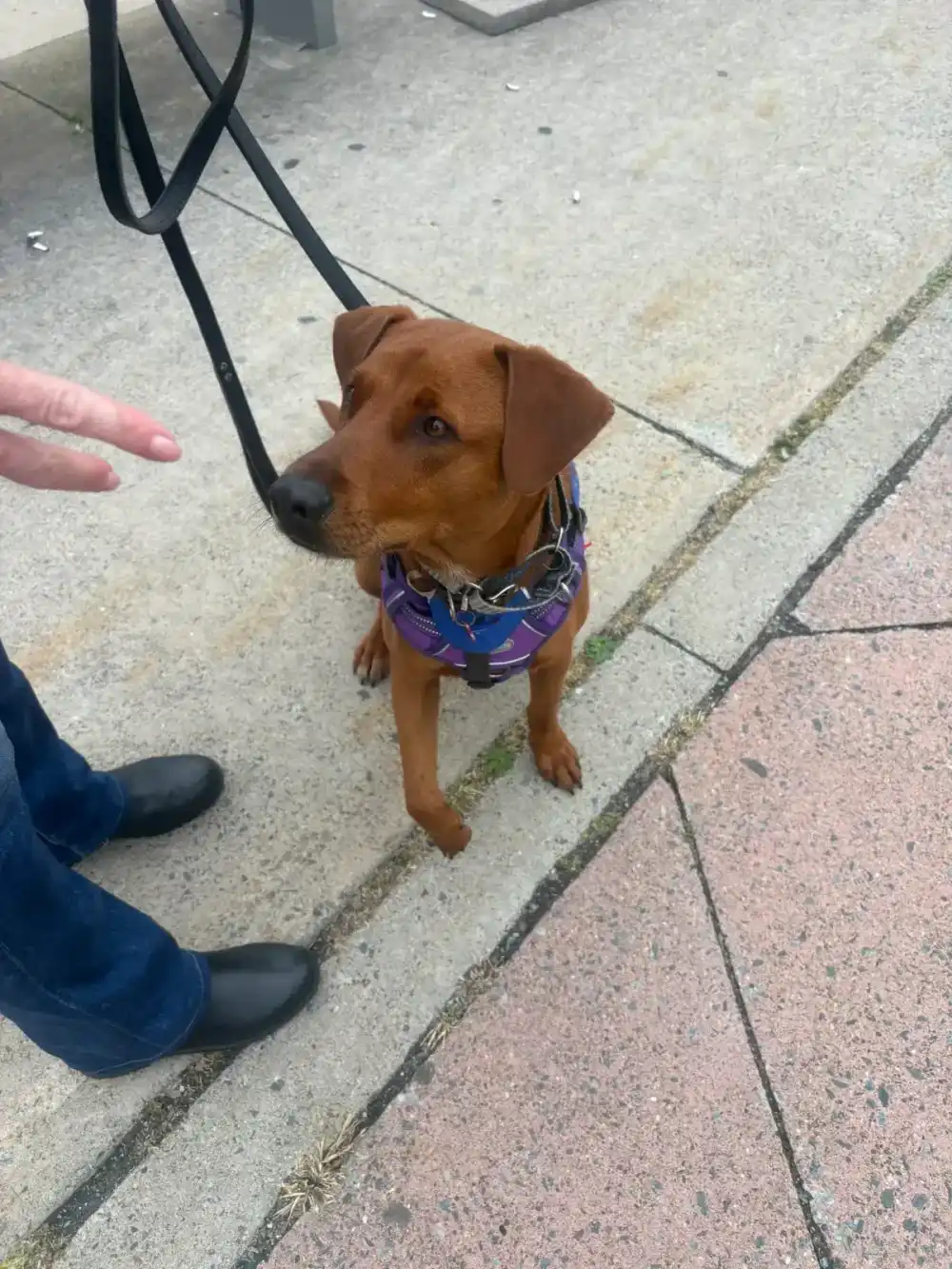
Confidence does not mean that a dog never startles.
Unexpected events happen in public. A door may slam. A cart may fall. Someone may move quickly nearby. A loud vehicle may pass. Another dog may bark from behind a fence.
The more important question is what happens next.
A suitable candidate should be able to recover after something unexpected happens. Recovery may include:
- Noticing the event.
- Showing a brief startle or moment of uncertainty.
- Looking to the handler for information.
- Returning to a workable emotional state.
- Re-engaging with the task or environment.
A dog that is briefly startled and then recovers may be showing a useful capacity for resilience. A dog that remains distressed, shuts down, scans continuously, attempts to escape, or cannot return to work may find public access work too difficult.
We do not want to rush a dog through challenging situations. Socialization is not about exposing a puppy to everything as quickly as possible. It is about developing confidence, resilience, and neutrality through carefully chosen experiences at a pace the dog can manage.
Progress must depend on stability and welfare. More exposure is not always better exposure.
Neutrality around people and dogs
Many people assume that a friendly dog would make a good service dog. That is not necessarily true.
A dog that wants to greet everyone is different from a dog that can work past everyone.
Service dogs regularly encounter people who may speak to them, reach toward them, stare at them, or move unpredictably. They may also encounter other dogs in narrow spaces, on sidewalks, in stores, or on public transportation.
A suitable dog must learn to remain neutral. Neutrality can look like:
- Not pulling toward people.
- Not soliciting attention while working.
- Not fixating on other dogs.
- Walking past distractions without barking or lunging.
- Returning attention to the handler.
- Settling quietly when there is nothing to do.
This does not mean your dog can never enjoy social interaction. It means the dog must be able to distinguish between working time and appropriate time off.
Health, structure, and comfort
Health is not a secondary consideration. A dog cannot work reliably if they are in pain or physical discomfort.
A suitability review should consider veterinary history, current health, stamina, movement, and the physical demands of the proposed tasks. Orthopedic and structural considerations are especially important. Joint disease, poor conformation, spinal concerns, instability, or other musculoskeletal problems may affect whether a dog can safely walk, settle, retrieve, climb, or perform other tasks.
Pain can also influence behaviour. A dog experiencing discomfort may become less tolerant of handling, more reactive, less willing to move, or less able to concentrate. These changes are not simply training problems.
Before investing heavily in a long training programme, discuss your dog’s health with your veterinarian. Depending on the dog’s history and intended work, additional assessment may be appropriate.
A working role must support the dog’s long-term welfare. It must not require the dog to work through pain.
Age, development, and breed misconceptions
A puppy can only be assessed as they are today.
An assessment may describe promising characteristics. It cannot guarantee the mature adult. Puppies continue to develop physically, socially, and emotionally. Adolescence can bring changes in confidence, distractibility, sociability, and reactivity. Health concerns may also emerge later.
This is why an assessment is a current suitability evaluation, not a promise about the future.
Our usual assessment window begins at six months old. As a general guideline, we assess potential candidates under four years of age for this training pathway. Age requirements exist because service dog training takes time and the dog needs a sufficient remaining working life after training is completed. The detailed reasoning belongs in a separate discussion about the best age to begin service dog training.
Breed alone neither qualifies nor disqualifies a dog.
Some breeds and lines may be more commonly represented in assistance dog work because of trends in temperament, health, size, or trainability. Individual dogs still vary considerably within every breed, crossbreed, and size category.
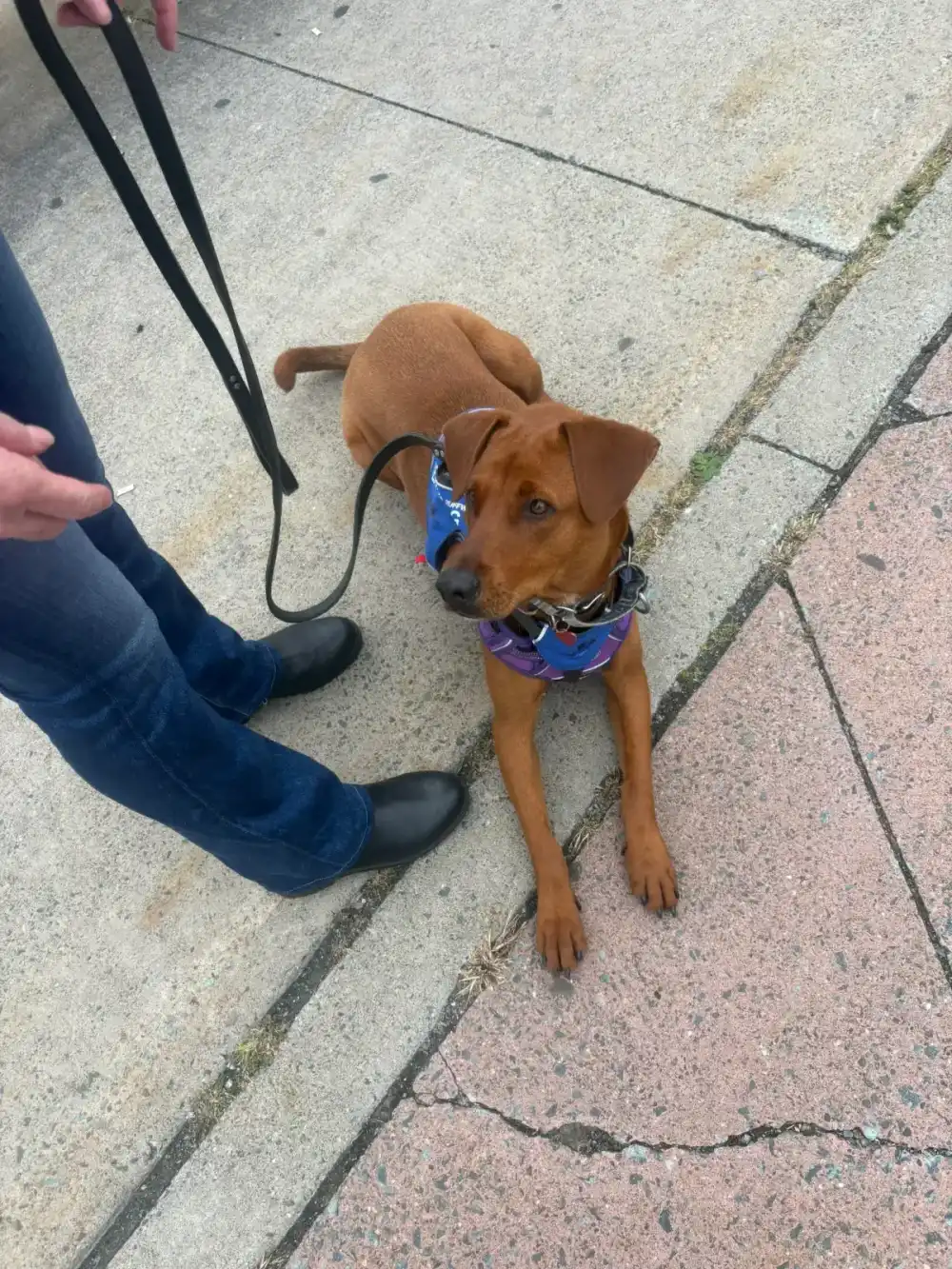
A small dog may be appropriate for certain tasks and not others. A large dog may have useful physical capability but may not be comfortable with the emotional demands of public work. A mixed-breed dog may be a good candidate, or may not be. We assess the individual in front of us.
Fear, reactivity, and realistic limits
A dog who needs more training is not automatically unsuitable.
Many dogs need support with leash skills, impulse control, settling, confidence, or distraction. These skills can often be developed through structured, humane training.
Fear and reactivity require closer consideration. A dog who occasionally hesitates in a new environment may need more time and carefully planned practice. A dog who regularly panics, attempts to flee, displays aggression, or remains highly distressed around people, dogs, noises, or handling may not be able to experience public access as comfortable.
The question is not whether we can force the behaviour to look controlled for a short period. The question is whether the dog can participate safely and willingly over time.
If public access is likely to remain stressful, career change may be the ethical decision. That is not a failure. It is a welfare decision. A dog can be a valued companion, succeed in another training activity, or contribute to your life in ways that do not require a service dog career.
What a Potential Service Dog Assessment can tell you
Our Potential Service Dog Assessment is $150 plus applicable tax. It is the practical first step for people who already own a dog and want an informed review before committing to a long programme.
The assessment considers factors such as:
- Temperament and emotional stability.
- Confidence and recovery after stress.
- Neutrality around people and dogs.
- Responsiveness to the handler.
- Environmental comfort.
- Handling and movement.
- Behavioural history.
- Health and veterinary information.
- The likely demands of the proposed service dog role.
The assessment is not a formality. It may identify strengths, concerns, training priorities, or a recommendation not to pursue service dog training.
It is also not a guarantee. Development, health, and behaviour can change. Dogs continue to be evaluated throughout training, including during the probationary period.
If a dog is accepted into our 12-month Owner-Trainer Program, the programme includes 104 hours of individualized training and costs $9,999.99 plus applicable tax. A $1,000 non-refundable deposit is applied toward the total cost. Acceptance does not guarantee that the dog will ultimately become a service dog.
You can review the Owner-Trainer Program curriculum, explore our service dog programs, or learn more about training your own service dog in Canada.
Assessment before commitment
Service dog training is a long-term process. It involves the dog, the handler, the trainer, and the wider community.
A responsible starting point is honest information. We will recognize your dog’s strengths, explain concerns clearly, and recommend the safest next step. Sometimes that step is training. Sometimes it is more observation and development. Sometimes it is choosing a different path.
An assessment is not certification. Pawsitively Service Dogs Inc. does not certify teams or guarantee service dog status. The province certifies teams; trainers prepare them.
Service dog certification is voluntary in British Columbia, Alberta, and Nova Scotia, and handlers are not required to register their dogs to train or work with them. Provincial access rules and qualification requirements differ, so review current government information for the province where you live and work.
If you are ready to discuss your dog’s potential, you can contact us.
Byline and contact
Melanie Burneau
Owner & Head Trainer
Pawsitively Service Dogs Inc.
- Nova Scotia: melanie@pawsitivelyservicedogs.ca
- British Columbia: jenn@pawsitivelyservicedogs.ca
- General inquiries: info@pawsitivelyservicedogs.ca
Sources and further reading
- Spotlight on Assistance Dogs: Legislation, Welfare and Research: peer-reviewed review of assistance dog welfare, selection, behaviour, and research limitations.
- Enhancing the Selection and Performance of Working Dogs: peer-reviewed review of working dog selection, health, behaviour, development, and welfare.
- Fear/reactivity in working dogs: an analysis of 37 years of behavioural data from the Mira Foundation’s future service dogs, peer-reviewed research from a Canadian assistance dog programme.
- Assistance Dogs International 2023 Compliance Guidance Notes: standards addressing temperament, health, behaviour, public access, assessment, and welfare.