A service dog’s work should have a clear purpose. The dog is trained to perform specific actions that help reduce the effects of a person’s disability and support daily functioning.
Those actions are not the same for every handler. There is no standard checklist that every service dog must complete. There is also no benefit in teaching tasks simply to make a dog appear more experienced or more qualified.
The right tasks are the tasks that meet your disability-related needs, can be performed safely, and support a reliable partnership over time.
Service Dog Tasks Are Individualized to the Handler
A task is a specific, trained action that mitigates the effects of a person’s disability.
For example, a dog may retrieve an item that its handler cannot reach, interrupt a behaviour connected to a psychiatric disability, or help the handler locate an exit during a period of disorientation.
The important elements are:
- The behaviour is deliberately trained.
- The behaviour is connected to a disability-related need.
- The behaviour provides practical assistance.
- The dog can perform it safely and reliably.
- The task is appropriate for that particular dog and handler.
This is different from a dog providing comfort simply by being present. A dog may be calming, reassuring, or emotionally supportive without performing a trained disability-mitigating task. Comfort and companionship can be valuable, but they are not automatically service dog tasks.
For a clearer explanation of this distinction, read our guide to service dogs and emotional support animals in Canada.
Examples of Service Dog Tasks
The following categories describe common examples. They are not a menu that every dog should work through. Your task plan should reflect your actual needs, your dog’s abilities, and the environments where assistance is required.
Retrieving Items
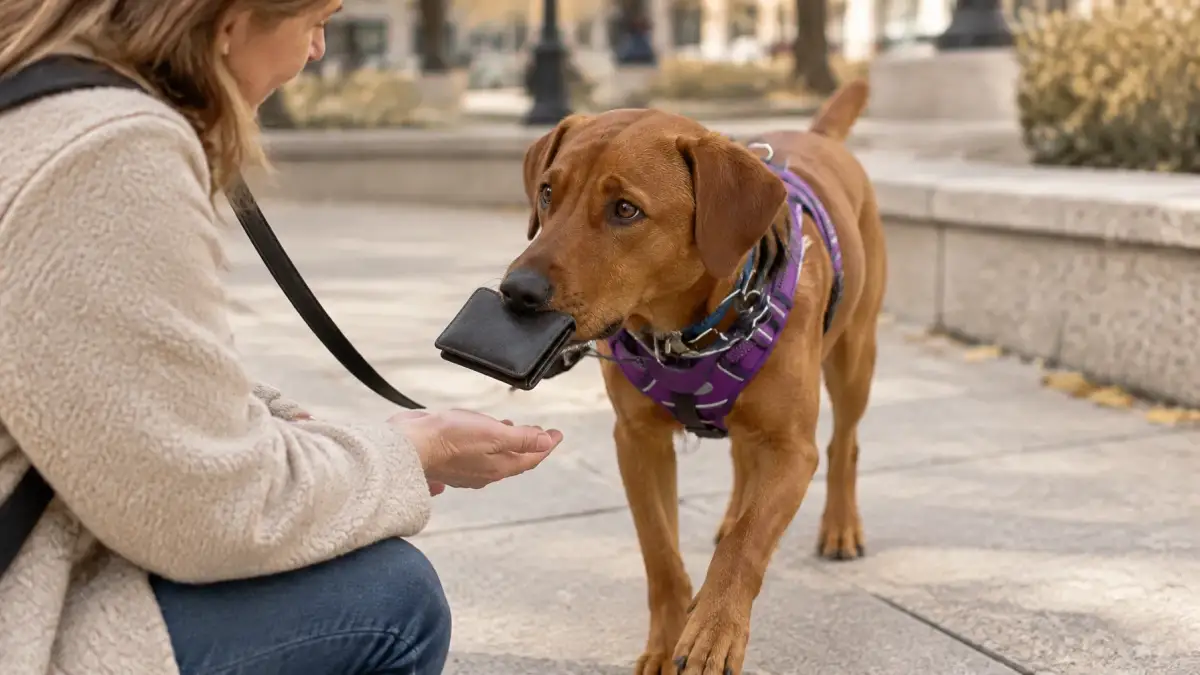
A dog may be trained to retrieve objects that are difficult or impossible for the handler to reach.
Examples include:
- Picking up dropped keys.
- Retrieving a phone.
- Bringing medication or an assistive device.
- Carrying a small personal item.
- Bringing a remote control or other household object.
- Taking an item to another person when help is needed.
Retrieval work involves more than picking up an object once. The dog may need to find the item, take hold of it gently, bring it to the handler, and release it into the handler’s hand. The task must also be suitable for the item and the dog’s size.
Interrupting or Responding to Behaviours
Some handlers need a dog to respond to behaviours or states associated with a disability.
A dog may be trained to:
- Nudge or paw the handler.
- Interrupt repetitive or harmful behaviour.
- Redirect the handler during dissociation.
- Prompt the handler to move to a safer location.
- Wake the handler from a nightmare.
- Provide a trained response when the handler is becoming distressed.
The response must be clearly defined. “The dog helps when I am anxious” is not yet a task plan. A trainer needs to understand what the dog should observe, what action the dog should perform, and what the handler will do next.
Responding to Medical Changes
Some service dogs are trained to respond to changes associated with a handler’s medical condition. Depending on the person’s needs and the dog’s demonstrated abilities, this may involve:
- Alerting the handler to a trained odour or cue.
- Retrieving medication or a phone.
- Activating an emergency alert system.
- Finding another person.
- Staying with the handler while help is obtained.
- Responding to a trained change in the handler’s behaviour or condition.
These tasks require careful planning and ongoing evaluation. A service dog should not be treated as a replacement for medical care, clinical support, prescribed treatment, or a medical alert device. If you have a medical alert need, discuss appropriate supports with your healthcare providers as well as your trainer.
Psychiatric Disability-Mitigation Tasks
Psychiatric service dog tasks are designed to address specific functional effects of a psychiatric disability. The task should be more specific than general companionship or emotional support.
Examples may include:
- Interrupting a panic response.
- Providing tactile grounding during dissociation.
- Waking the handler from a trauma-related nightmare.
- Creating space around the handler when specifically cued.
- Leading the handler to a planned exit or quiet location.
- Turning on a light or checking a designated area.
- Prompting the handler to begin an essential routine.
- Finding another person when the handler cannot safely seek help independently.
Not every behaviour that feels comforting is a task. A dog lying beside its handler may provide genuine emotional support. It becomes a trained task when the dog has been taught to perform a defined action that addresses a disability-related limitation.
Deep Pressure
Some handlers use trained deep-pressure contact as part of a psychiatric disability-mitigation plan.
The dog may be taught to:
- Place its body across the handler’s legs.
- Rest against the handler’s torso.
- Apply pressure when cued.
- Remain in position for a defined period.
- End the task when released.
Deep pressure is not appropriate for every dog or every handler. The dog’s size, structure, comfort, positioning, and ability to move away must be considered. The dog should never be forced to provide physical contact, and the task should not create pain, distress, overheating, or restricted movement.
Mobility-Related Assistance
Some dogs are trained to assist with physical or mobility-related needs. Examples can include:
- Retrieving objects.
- Opening or closing suitable doors.
- Pulling a lightweight item designed for that purpose.
- Helping the handler locate a seat or stable surface.
- Providing positional support in carefully defined circumstances.
- Guiding the handler around obstacles where appropriate.
Bracing, counterbalance, and weight-bearing work require particular caution. A dog’s size, age, physical development, structure, conditioning, and health all matter. Not every dog is physically suitable for this work, and a task that appears simple may place significant strain on a dog.
A well-trained behaviour can still be the wrong choice for an individual dog. Deciding not to train a task is a responsible outcome when safety or welfare cannot be maintained.
Locating a Person, Exit, or Object
A dog may help its handler locate something important in a familiar or planned environment.
Possible examples include:
- Finding a support person.
- Locating an exit.
- Finding a designated room.
- Locating a dropped item.
- Leading the handler back to a planned meeting point.
- Finding a quiet area when the handler is overwhelmed.
These tasks need clear boundaries. A dog should not be expected to navigate every unfamiliar setting independently or make complex safety decisions without appropriate training and handler support.
Help-Seeking Behaviours
Some handlers may benefit from a dog trained to seek assistance.
This could include:
- Approaching a designated person.
- Carrying a communication card.
- Activating a call button.
- Leading someone back to the handler.
- Barking or using another trained signal in a defined emergency situation.
Help-seeking work must be carefully controlled. Unprompted barking, approaching strangers, or leaving the handler can create safety and access concerns. The dog needs to understand when the behaviour is required and when it is not.
Task Training Requires Progression
A task is not complete because a dog performed it once during a lesson.
Reliable task work develops through stages:
- Define the need. Identify the disability-related limitation and the practical assistance required.
- Select the behaviour. Choose an action that is clear, achievable, and safe.
- Introduce the task. Teach the dog what action to perform and what outcome is expected.
- Strengthen the response. Practise until the behaviour becomes consistent.
- Add appropriate cues. Teach the dog when to begin and when to stop.
- Generalize the task. Practise in different rooms, locations, surfaces, and routines.
- Rehearse real situations. Work in the environments where the handler actually needs assistance.
- Monitor the partnership. Review reliability, stress, physical comfort, and changing needs.
Progression should depend on demonstrated competence. If the dog becomes uncertain, stressed, physically uncomfortable, or inconsistent, the plan should be adjusted. More difficulty is not always better progress.
Our article on how long service dog training takes explains why structured development requires time and repetition.
More Tasks Do Not Mean a Better Service Dog
A service dog is not improved by collecting tasks. The goal is not to create the longest possible task list.
A smaller number of dependable tasks may provide more meaningful support than a large number of behaviours that are rarely needed or cannot be performed consistently. A task should earn its place in the training plan by meeting a real need.
We consider:
- What assistance you require in daily life.
- How often the task is needed.
- Whether the dog can perform it safely.
- Whether the task is practical in your usual environments.
- Whether the dog can remain comfortable and engaged.
- Whether you can provide clear cues and follow-through.
- Whether the task supports long-term welfare for both of you.
At Pawsitively, we build task training individually through our service dog programs. We work with the handler to identify useful goals, develop the behaviour in stages, and review whether the task remains appropriate as training progresses. Our owner-trainer curriculum provides more information about this structured approach.
Building Useful, Sustainable Work
The best task plan is practical, individualized, and welfare-conscious. It supports your independence without asking the dog to work beyond its abilities.
Task training is a partnership. You bring knowledge of your daily needs. Your trainer brings training structure and observation. Your dog provides feedback through behaviour, comfort, and consistency.
Together, you can build skills that are useful, reliable, and appropriate for real life. To learn more about our service dog programs, review the available options or contact our team.
Melanie Burneau
Owner & Head Trainer
Pawsitively Service Dogs Inc.
Nova Scotia: melanie@pawsitivelyservicedogs.ca
British Columbia: jenn@pawsitivelyservicedogs.ca
General inquiries: info@pawsitivelyservicedogs.ca